
INTRODUCTION
According to a recent Surgeon General’s Report, loneliness and social isolation are now at epidemic levels in the United States (US), with 50% of adults reporting loneliness (U.S. Department of Health and Human Services, Office of the Surgeon General 2023).
As defined in the report, loneliness and social isolation are not the same thing. Loneliness encompasses a feeling or subjective distressing experience that results from perceived isolation or inadequate meaningful connections; here, inadequate refers to the discrepancy or unmet need between an individual’s preferred and actual experience. Social isolation, however, is measured objectively in terms of having few social relationships, social roles, or group memberships, and infrequent social interactions.
The health consequences of loneliness and social isolation have been reported to be equivalent to smoking 15 cigarettes per day or having alcohol use disorder—leading to both short and long-term adverse effects on a person’s health (U.S. Department of Health and Human Services, Office of the Surgeon General 2023).
In fact, researchers have found links between feelings of loneliness and social isolation and a range of adverse health outcomes including depression, poor sleep quality, accelerated cognitive decline, impaired immunity, increases in suicidal ideation/attempts and self-harm, risk of stroke (32%) and coronary heart disease (29%), and risk of premature mortality by 26% (loneliness) and 29% (social isolation), respectfully (Holt-Lunstad et al. 2015). There are also reported risks for anxiety, dementia, and a potential increase in susceptibility to viruses and respiratory illness (Shankar 2023). Shankar (2023) also reported that while loneliness and social isolation have affected people throughout history, the COVID-19 pandemic did exacerbate these problems resulting in further declines in physical and mental health. Based on these findings, the importance of screening for loneliness, social isolation, and depression in various settings such as education, workforce, and healthcare are emphasized.
A range of published reports also have conveyed the impact of loneliness and isolation on different age groups. A study by Lara et al. (2019) found that over a three-year period, loneliness and social isolation was linked to lower cognitive function in middle-aged and older adults, with loneliness having a greater impact; this association remained significant even after excluding individuals with depression. Further, they found that socially isolated individuals may be more prone to engaging in unhealthy behaviors, including poor diet, physical inactivity, and increased smoking and alcohol use. Donovan and Blazer (2020) reported on the findings of the National Academies of Science and Engineering and Medicine (NASEM) (National Academies of Sciences 2020) on social isolation and loneliness in persons 50 years of age and older, which highlight the link between social isolation and loneliness and increased risk for coronary artery disease and stroke independent of traditional risk factors, as well as associations with depression, dementia, suicidal ideation and self-harm, anxiety, and poorer quality of life in this population.
However, when Holt-Lunstad et al. (2015) studied the health risks of loneliness and social isolation among different age groups they found that while older adults (over 65 years of age) are at risk, they identified a stronger link between social isolation and unhealthy behaviors among middle-aged adults (under 65 years of age). They suggest this may be due to enhanced resilience among older adults that enables them to function well alone as compared to younger adults. Data from the 2023 Surgeon General’s Report (U.S. Department of Health and Human Services, Office of the Surgeon General 2023) also show that those with strong social connections have a 50% lower risk of early death.
More recently, it was reported that younger individuals are now at an increased risk for loneliness and social isolation, and that this was exacerbated during and after the COVID-19 pandemic (Shankar 2023). When looking at other underlying causes, issues such as identity formation, individuation from family, and life transitions, such as experiencing new environments such as moving to college, which are often distinct and connected to life stages, have been specifically related to loneliness among young people (Shah and Househ 2023). Williams and Braun (2019) reported that studies have shown that while loneliness affects a significant portion of the US, it is more prevalent among teenagers (70%) and young adults (48.3%), whereas older adults (aged 72 years and older) report lower rates (38.6%). This is especially important to note as the assumption might be that only older adults are affected, especially in states such as Florida where a higher number of older individuals reside. Further, in support of both groups of findings reported here, Shah and Househ (2023) reported that the distribution of loneliness is U-shaped across the lifespan, with both younger and older people being most affected.
To help address these issues, the Surgeon General’s Report from 2023 also proposed a national strategy to combat loneliness and social isolation that included six pillars including strengthening social infrastructure in local communities, enacting pro-connection public policies, mobilizing the health sector, reforming digital environments, deepening our knowledge, and cultivating a culture of connection (U.S. Department of Health and Human Services, Office of the Surgeon General 2023). Overall, there are various health-related reasons to address loneliness and isolation, and a growing need for more rigorous and theoretically-guided research to better inform interventions that can successfully prevent and address loneliness and social isolation across a range of populations, including communities in Florida and beyond. To that end, the Activist Lab at the University of South Florida College of Public Health took on the challenge of identifying and addressing loneliness and social isolation in the state of Florida.
The Activist Lab: Who We Are and What We Do
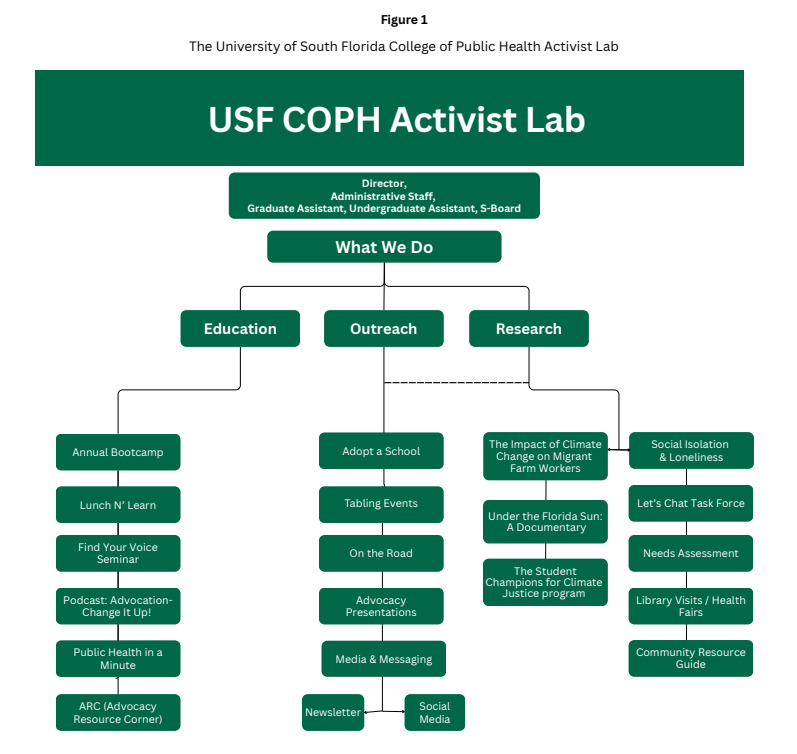
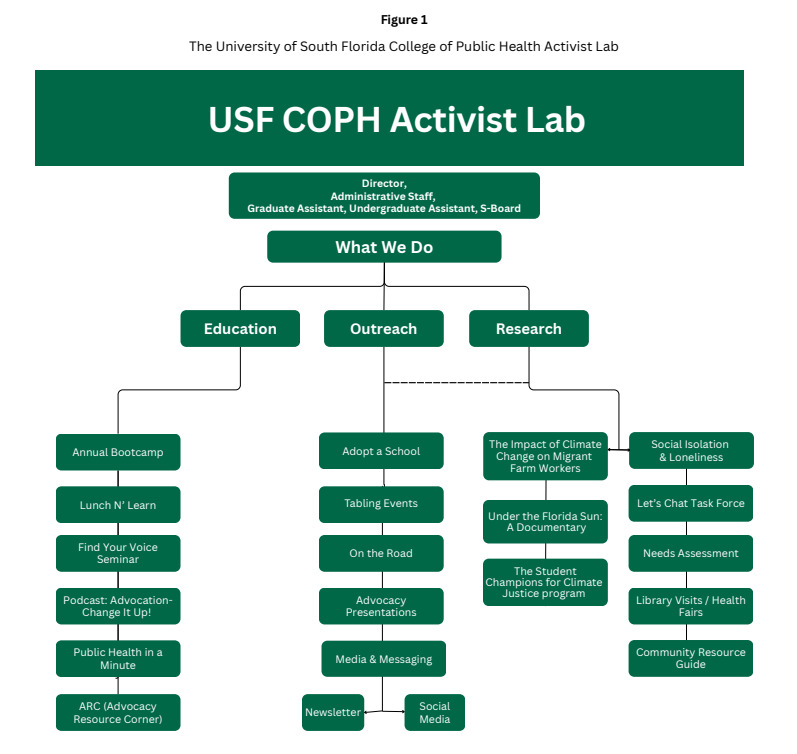
The Activist Lab at the University of South Florida College of Public Health prepares students to be exemplary advocates and leaders in public health and leads several education, research, and outreach efforts each year covering a variety of public health issues (University of South Florida College of Public Health, n.d.). The Activist Lab was founded by a faculty member (K. Liller) and is led by Dr. Liller and a student advisory board comprised of 10-12 undergraduate and graduate public health students. The Activist Lab initiates and completes at least 70 initiatives a year. Some examples include an annual 2-day virtual bootcamp, podcast episodes, funded research, “boots on the ground” experiences including presenting at conferences, meeting with legislators, educating middle school students about advocacy (Adopt a School project), tabling and other events showcasing strategies for achieving positive change, seminars featuring topical experts, and more. Figure 1 provides the framework of the Activist Lab.
The Activist Lab Board and faculty mentor choose at least two public health topics per year as the major focus areas for their efforts. In 2022, the College’s Community Advisory Board (COPH Advisory Council Directory.pdf | Powered by Box) consulted with the Dean to see if the College could tackle the topic of loneliness and social isolation and hopefully develop outreach programs that would enhance knowledge and bring this topic more to the forefront. The Dean reached out to the Activist Lab to see if initiatives could begin in this area. This was the starting point of the work described below.
Activist Lab Projects and Outcomes
Over the past three years (2023-2025), the Activist Lab initiated a statewide effort to address loneliness and social isolation. These efforts have included developing a task force in partnership with the Florida Public Health Association to strengthen the reach and effect of these efforts. The taskforce set out to work on 1) development and implementation of a statewide needs assessment tool to identify levels of loneliness and social isolation across the state, 2) outreach to a range of communities and age groups about the importance of these topics, their harmful health effects, and how to prevent them, and 3) educational seminars for lay and professional audiences. The specific projects led by the Activist Lab in each of these focus areas and their outcomes are detailed below.
Creation of a Statewide Task Force and Needs Assessment
In 2023, the Activist Lab formed a partnership with the Florida Public Health Association to develop a statewide task force focused on providing education on the health effects of loneliness and social isolation. The task force met monthly to discuss the strategies of the different agencies involved such as connecting with seniors in communities with weekly phone calls and information about resources, health fairs, working with veterans on health care issues including suicide prevention, development of educational portals, and how best to coordinate efforts. Because there was no baseline statewide information on the extent of loneliness and social isolation in the Florida population, one of the first projects the group took on was the development of a needs assessment.
The assessment was developed to include questions from the short version of the UCLA 3-item tool (Hughes et al. 2004), which asks: how often do you lack companionship, feel left out, and feel isolated. The task force agreed it was also important to add additional questions about feeling lonely and social connections. To assess loneliness, participants were asked how often they feel lonely. To assess social connection, participants were asked how many social connections one has with friends, family, and partners that are supportive and satisfying, in addition to a question about the desire for more positive connections.
The needs assessment was sent via Qualtrics to University of South Florida College of Public Health faculty, staff, and students, the membership of agencies represented by the task force, and the Florida Public Health Association, which included a diverse group of public health and social agency workers. We estimate approximately 4000 individuals were sent the assessment. Respondents had to be at least 18 years of age and have resided in Florida for at least six months; respondents who reported being in the military and residing outside of Florida for six months or more but provided proof of Florida residency were also permitted to participate. The Institutional Review Board of the University of South Florida determined this project to be exempt from oversight due to it being an evaluation and of minimal risk to participants. Consent was provided by all participants after their eligibility was confirmed and before they completed the assessment.
The results of the needs assessment showed that 421 individuals began the assessment and, depending on the question, 380-385 responded, producing a response rate of over 90% (90.26-91.45%). Data from participants who completed the assessment but did not give consent or were not eligible were not included in the analysis. The sex of the respondents was mostly reported as female (83% female, 15% male). Most respondents were under age 35 (33% aged 18-24, 18% aged 25-34, and age groups 35-44, 45-54, and 55-64 each had 15%), and the majority of respondents reported their race as non-Hispanic white (72%). A high percentage of respondents reported having a bachelor’s and/or master’s degree (60%) and being employed full-time (65%).
In terms of the responses to how often do you feel you lack companionship (N=385), 51% reported some of the time and 16% reported often, for a total of 67% of respondents indicating some lack of companionship. Feeling left out was reported by 52% of respondents as some of the time with 16% reporting often, for a total of nearly 70% of participants indicating some level of exclusion. Forty-four percent of respondents reported feeling isolated from others at least some of the time with 17% reporting often, for a total of over 60% of respondents indicating some level of isolation. The majority of respondents (52%) reported feeling lonely some of the time and 17% reported often, for a total of nearly 70% of respondents indicating some level of loneliness. Regarding the number of supportive and satisfying social connections one has on a typical day, most respondents reported 1-2 (40%), followed by 3-4 (38%) and then 5 or more (22%). When asked if the respondents would like more social connections in their lives, 72% responded “Yes”. Table 1 includes the full list of assessment questions and results. Due to the fact that this project recruited a convenience sample and was done to gather preliminary information, additional analyses were not conducted but further and more rigorous assessments are planned.
Overall, the results of the needs assessment showed that among this younger Florida population of mostly women, the majority feel lonely, isolated, left out, and lack companionship at least some of the time. Also, over 70% of respondents reported wanting more positive social connections in their lives. These results are in line with previously reported findings of Shah and Househ (2023), Shankar (2023), and Williams and Braun (2019), which showed the importance of addressing loneliness and social isolation among a younger population, not only among older individuals, which might have been the assumption prior to the needs assessment.
Hosting Educational Events in Our Communities and on Campus
Based on our literature review, the Activist Lab and task force members realized the need to educate more individuals about the impact of loneliness and social isolation. Applying the findings of the Surgeon General’s report (U.S. Department of Health and Human Services, Office of the Surgeon General 2023) in conjunction with the results of the needs assessment, the group decided to develop handouts to provide key information about and resources for addressing loneliness and social isolation and used that same information to draft questions that were asked to individuals who attended the educational sessions and tabling events. To drive interaction and build awareness at these events, the group created questions for the “Activist Lab Wheel”; an event attendee spins the wheel, and, depending on what space the wheels stops on, answers open-ended, multiple choice, or true and false questions related to the health and social welfare outcomes of loneliness and social isolation; individual responses and correct answers are then discussed with participants. A list of questions created for use at events with the Wheel are included in Table 2.
To expand outreach into more community settings, the Activist Lab reached out to several local retail establishments to advocate for tabling events where information about loneliness and social isolation could be shared; however, many businesses were not willing to participate due to concerns that the presentations might be a bother to their patrons and perceptions that a product was being sold. The group did identify one local restaurant that was interested; however, the group was told by retail managers that their patrons did not want to spend time talking while eating or waiting for their food. After consulting with several public health organizations on the task force, the group began holding educational programs at a local library, which proved to be a more successful way to reach community members.
During the first event at a local library, patrons asked Activist Lab members for a resource guide showing where in the community they could find resources to meet their health and transportation needs and to stay connected within their communities. The request was not unexpected since poor health and poor transportation can often be linked to feelings of loneliness and isolation. To respond to this request and advocate for library patrons, the Activist Lab worked with the library to gain approval to develop a resource guide in hard-copy and digital formats that the library then posted and shared. See Supplemental Materials for an excerpt from the guide. In addition, the task force went on to host a wellbeing fair at the library specifically focused on addressing loneliness and social isolation that included representatives from several agencies across the state represented on the task force including the Department of Veterans Affairs, Seniors in Service Program, and the Florida Department of Health, who each shared resources and information about where their services could be found. Activist Lab members also participated in a range of local and state health fairs and other outreach events from 2023-2025.
In partnership with the College, the Activist Lab held several tabling events during student orientation and in conjunction with other health events at the university and offered several guest lectures across campus. These activities were very advantageous in reaching a younger population with information about loneliness and social isolation and how to advocate for support as well as information about other public health topics and issues that students care about such as food insecurity, climate change, distracted driving, and mental health. The goals of these on-campus tabling sessions were to share information, encourage healthy behaviors, provide information about the Activist Lab and its community partners, and inspire more student involvement.
On the legislative level, the Activist Lab’s efforts have included working with legislators and advocacy groups to enhance connections in the workplace through workplace education events. The Activist Lab holds an annual bootcamp on campus where legislators and advocates work together to build advocacy and policy initiatives to strengthen public health. In the bootcamp, participants form teams and develop position papers focused on how to create change on a particular topic. When creating recommendations, they consider not only the magnitude of the issue but also how to best communicate their position. The position papers are then critiqued by invited legislators and advocates. In 2023, the Activist Lab and a group of interdisciplinary professors from the University were invited to give an oral presentation at the annual meeting of the Florida Public Health Association on morbidity and mortality related to the epidemics of loneliness and social isolation and how to reach communities. The presentation included a detailed discussion about the Surgeon General’s Report (U.S. Department of Health and Human Services, Office of the Surgeon General 2023) and roles for changing the social, service, and built environments. One researcher also presented prior work examining the impact of longitudinal associations of social connection and loneliness on episodic memory, function, and depressive symptoms in stroke and other stress models.
DISCUSSION
Over the last three years (2023-2025), the Activist Lab and statewide task force have addressed the issues of loneliness and social isolation in Florida through this multi-pronged strategy. Although the findings of the needs assessment were not representative of all Floridians, it was an essential step to gather baseline information, which did identify a need and pointed to a specific need to address loneliness and social isolation across age groups, which requires different approaches. However, more work is needed to gain a fuller picture of the state of loneliness and social isolation in Florida and to build a strong advocacy plan. For example, it would be interesting to explore why one-third of respondents to our needs assessment reported hardly ever or never experiencing loneliness and/or social isolation; insights about their experiences and strategies could be applied to help others and guide future interventions.
Our efforts followed several of the pillars put forth by the Surgeon General (U.S. Department of Health and Human Services, Office of the Surgeon General 2023), particularly mobilizing the health sector, deepening knowledge, and building a culture of connection. The literature on developing interventions to address loneliness and social isolation stresses the importance of studying interpersonal and structural contributors to inform interventions (Usama et al. 2024). For example, these authors highlight contributors including age, in terms of the potential for increased impact among older and younger groups, and membership in minority racial and ethnic groups. Authors also highlighted a critical role for clinicians in terms of screening for social isolation and loneliness and providing accessible resources and support.
Since 2024, strategic planning efforts have been taking place within the Activist Lab and the ongoing task force to expand the needs assessment, with a focus on reaching more diverse groups of community members across the state to determine significant differences across age groups and other demographic markers. With this information, more specific goals and objectives can be determined to support the development of more targeted outreach efforts along with detailed plans for process and impact/outcome evaluations to assess increases in knowledge and behavior changes that can ultimately lead to reductions in loneliness and social isolation and support positive change.
One part of the strategic plan includes expanding education in the schools. The Activist Lab already leads an initiative called “Adopt a School” where interactive and innovative curricula are used with middle and high school students to teach healthy behaviors and how to be advocates for change. In the future, the topics of loneliness and social isolation will be included in this initiative to build understanding and encourage students to advocate within their own schools to enhance social connections. For example, students will be prompted to brainstorm ideas, discuss what makes connections positive, develop position papers, and advocate to their school’s administration for the changes they want to see. Other potential ideas include additional group activities, field trips, and new and/or expanded opportunities for students to spend more time engaging with one another.
When Grillich et al. (2023) pooled the findings from systematic reviews of the effectiveness of various interventions to prevent loneliness and social isolation among community-dwelling older adults, their results showed that interventions could potentially reduce loneliness, however there was less effect on social support. They did note that while information and communication technologies can be effective in decreasing loneliness if appropriately targeted to younger age groups, they might also increase feelings of loneliness and isolation such that more in-person social connections are needed. These concepts and approaches will be integrated into future discussions about the Activist Lab’s strategic plan and how best to expand this work. A first next step will be to seek input from diverse populations through focus groups and other qualitative methods to determine the best communication methods and other strategies to reach a range of populations.
Community groups and organizations also have a role to play in addressing these topics by not only providing education but partnering with people and programs within universities and colleges such as student and faculty advocacy and counseling groups, as well as collaborating with local public health departments and national professional public health associations. These kinds of partnerships and collaborations can lead to greater participation and the development of a wide variety of tools and approaches that can build community, county, and statewide awareness and support for more widespread prevention efforts.
Health professionals also have a key role to play in this work through patient education initiatives and discussions with patient families. Healthcare facilities and systems can play a powerful role in providing education, advocating for adding questions about loneliness and social isolation to patient intake forms and electronic medical records, sharing resources, and, of course, providing dedicated care including counseling. In the clinic setting, the use of artificial intelligence and electronic medical records can be useful for tracking concerns and outcomes that can serve as critical data to support future research studies.
Future outreach efforts of the Activist Lab also may include additional education sessions, webinars, a social media campaign, and expanded advocacy for local and state grant funding to build on current efforts and meet newly identified needs. Methods to advocate for community, state, and federal grant and in-kind support for education and change efforts in the workplace and community setting to decrease loneliness and build social connections are also planned for development. This work might also include efforts to better understand more about the causes of increased loneliness and social isolation by taking a more intersectional approach that may include a deeper understanding of social and structural factors related to the economy, healthcare systems, etc. A better understanding of these factors can lead to more effective, multi-level advocacy approaches and outreach efforts.
Overall, this process highlighted the need to develop efforts based on local needs and the important role of states, since many public health initiatives are organized, determined, and led by state-level organizations who closely consider the needs and concerns of their residents. For example, some states have created focused efforts such as the Massachusetts Social Hubs Initiative (The Chelsea Hub: Connecting At-Risk Populations to City Services Shelterforce) where social service groups and agencies meet together to develop solutions for client services and health systems, and models such as SCAN Health Plan and Commonwealth Care Alliance (SCAN and Commonwealth Care Alliance Partner to Launch myPlace Health) that have integrated loneliness assessments and interventions into their care plans.
In Florida, prior efforts to combat loneliness and social isolation mainly occurred through a mix of public and private programs that primarily targeted older adults, veterans, and other vulnerable populations. These efforts have included leveraging technology, providing mental health resources, and organizing community-based activities. Newer programs being planned now will reportedly focus on utilizing social marketing principles to brand efforts. Going forward, our hope is that sharing this work, driven by the close collaboration between the Activist Lab and the Florida Public Health Association over the past three years to uncover the needs and populations most impacted and deliver educational information and events, will lead to even more effective programs and outcomes for a range of populations who experience loneliness and isolation across the state of Florida.
The combination of academic—including the vital role of students—public health, and community support is essential to reverse and prevent the negative health consequences of loneliness and social isolation in Florida and throughout the US. By working to build awareness and support, the Activist Lab has taken these first essential steps and continues to work for broader and sustained positive change in Florida. We hope that other groups will learn about what we have accomplished and model some of this work to expand understanding and action on the critical issues of loneliness and isolation in their states.
Acknowledgements
The authors wish to acknowledge the Florida Public Health Association and the Let’s Chat Task Force for their collaboration with the USF COPH Activist lab to decrease loneliness and social isolation in Florida.
Author Contributions
KL conceptualized the project, designed the methodology, led and supervised the events, led the analysis of the findings, evaluated the findings, and led the development and revisions of the manuscript. MK assisted with project design and implementation, assisted with data analysis, and helped develop the initial manuscript and revisions. HH led the development of the Qualtrics version of the needs assessment, implemented the needs assessment, performed the data analysis, and assisted with initial preparation of the manuscript. GH helped lead the Let’s Chat Task Force and the community interventions and assisted with the design of the project and its implementation. The Let’s Chat Taskforce members assisted with the initial design of the needs assessment and helped lead the community interventions.
Funding/Support
The work of the Activist Lab is funded by the University of South Florida College of Public Health.
Abbreviations
USF COPH, University of South Florida College of Public Health
Conflict of Interest Disclosure
There are no conflicts of interest among the authors or settings to disclose.