
INTRODUCTION
In the United States, voter turnout trails behind other nations with similar sized economies (DeSilver 2022). In recent elections, approximately two-thirds of eligible voters participated in voting (Hartig et al. 2023). This is important because civic engagement—defined as any individual or group action to address issues of public concern such as voter participation—is important from a public health perspective (Adler and Goggin 2005). In particular, the act of voting has been linked to improved health outcomes, meaning individuals and communities with increased voter participation have been shown to have better health outcomes (Kim and Kawachi 2006).
In pediatric health care, higher voting participation among parents and caregivers of pediatric patients has been associated with fewer days that their children spend hospitalized, which is believed to be secondary to the known association between civic engagement and healthy communities (G. Kelly et al. 2021). In a recent qualitative analysis, parents of pediatric patients reported that they found voting to be directly related to community health and wellbeing, furthering the conception of the impact of voting beyond its potential effects on individual children (Jones et al. 2025). Further, in the same study, parents reported feeling that voting is a marker of “social cohesion” and an avenue to influence child health funding (Jones et al. 2025). In addition to a positive association between voting and health status, the American Medical Association (AMA) has declared voting to be one of the social determinants of health (AMA 2022)—meaning that voting itself is considered to be a driver of health across the US.
Beyond the potential impact that voting itself may have on individual and community health outcomes, voting is a nonpartisan activity that is integral to advancing health policies across the political spectrum and important for addressing health inequities. However, lower-income communities have been shown to have both lower voter registration rates and poorer health outcomes—facets that are intricately intertwined with historical, sociopolitical, and medical disenfranchisement (Blakely et al. 2001; Brown et al. 2020).
The National Voter Registration Act of 1993 set the legal standard for permitting voter registration efforts in healthcare settings (Department of Justice 2024). Following on this, there have been several recent efforts to increase voter registration in the healthcare setting, which had been previously limited by a lack of resources and tools, and fears related to legality (Martin et al. 2021). Many of these recent efforts have focused on engaging physicians (Grade et al. 2023; Junior et al. 2023; Martin et al. 2021), since it has been reported that physicians vote less than those in comparable professions, such as lawyers, engineers, educators, and executives, and about 20% less than the general population; this is frequently self-attributed to busy and inconvenient schedules (Lalani et al. 2021; Lalani and Hong 2022; Solnick et al. 2021). However, in the pediatric landscape, parents and caregivers have reported interest in discussing voting with their child’s physician and other care providers, such as social workers, as well as receiving virtual messaging about voting via email or the electronic medical record (Jones et al. 2025).
For all these reasons, the healthcare setting can and should serve as an avenue to increase voter registration across various groups—physicians, health care providers and staff, and patient families. People of all demographics and backgrounds engage with healthcare settings, so such settings may serve as trusted touchpoints for civic participation (Bajaj et al. 2021).
To achieve this in our healthcare system, our team aimed to conduct a nonpartisan voting campaign focused on mobilization, education, and registration at a Children’s National, a large, urban, children’s hospital located in Washington, D.C. In this case study, we share the steps we took and lessons we learned in this process with the hope that other health systems can model what we have done and improve on our process in their own settings and contexts.
CASE DESCRIPTION
Setting: People, Place, and Time
Our institution treats over 250,000 patients annually from across the country and world, although most patients reside in Maryland (56%), Washington, D.C. (24%), and Virginia (15%), with over 50% covered by Medicaid (Children’s National Hospital, n.d.). The unique location of the hospital, with its 17 primary care centers and 16 specialty care sites, results in a diverse patient population. Most patients reside in three distinct voting areas (two states and one district) that each have their own set of voting rules, regulations, and policies. The hospital system’s approximately 8,000 employees also primarily reside in these same voting districts.
For our voter registration drive, a small working group of individuals with advocacy-focused careers, as reflected in their formal academic titles and career interests, initially came together to initiate and facilitate the campaign. To our knowledge, this was the first system-wide voter registration drive at our institution.
Our work started in June 2024 and extended beyond the U.S. general election in November 2024. We designed a roadmap for our voter registration efforts on a six-month timeline leading up to the November election. Our voter engagement efforts focused on four primary groups including patients and families and hospital administration and staff. Our team defined voter mobilization as the process of motivating individuals to vote; voter education as the process of informing key constituents and eligible voters on voting processes, rules, and regulations; and voter registration as the process of aiding eligible voters in registering to vote. At our institution, our project was characterized as a “Quality Improvement Initiative” and did not constitute human subjects’ research. As such, it was not under the oversight of our Institutional Review Board.
KEY ACTIVITIES AND ACTIONS
Engage Hospital Leadership
Our first step was to engage with our medical center leadership to garner the support of various key constituents and hospital leaders. For our campaign, we engaged the Chief Executive Officer and the Vice President of Community Engagement, Advocacy, and Government Affairs to receive approval for staff to engage in this work—including during patient and family encounters. We also engaged the Executive Director of Community and Government Affairs (co-author DDlT) for operational support and connections to key institutional departments such as marketing, communications, and interpreter services.
We worked closely with our hospital leadership to discuss the best next steps to take and openly communicated with them throughout the entire campaign.
Select, Create and Adapt Education and Engagement Materials for Voter Education
While we were still in the process of engaging our leadership, we looked to create a variety of education and engagement materials in English and Spanish, the most common languages spoken by our patient population. Our materials included only nonpartisan information on voter registration and voter participation that incorporated the various voting regulations of each distinct jurisdiction relevant to our patients, family, and staff.
We chose to use materials developed by Vot-ER, a nonpartisan nonprofit organization comprising hundreds of partners nationwide with the goal of improving voter registration in the healthcare space (Ruxin et al. 2022; “Vot-ER” 2026), and the American Academy of Pediatrics (AAP), which leads a nonpartisan “Get out the Vote” campaign to support voting among pediatricians and assist families and patients in voting (AAP 2024). Since 2020, the AAP has partnered with Vot-ER to provide tangible tools to support their voter registration and engagement campaigns. We implemented methodologies combining our own approaches and materials as well as those informed by Vot-ER and AAP.
We used the following materials to engage patients, family, and staff in voting education:
-
The Vot-ER badge is a physical badge with a quick response (QR) code that individuals can scan directly from their personal devices. The QR code directs users to the Vot-ER website, where they can choose from options including: 1) checking their voter registration status, 2) registering to vote, 3) seeing voting information, 4) requesting a mail-in ballot, 5) learning how to vote from within the hospital via an emergency absentee ballot for hospitalized eligible voters, and 6) talking to a support person. Vot-ER tracks the amount of engagement with the QR codes on badges, flyers, and other materials. This data includes the number of QR code scans (which takes the user to the main “landing page”), the number of “Voter Registration” clicks (including “Register to Vote” and “Check Your Registration”), and the number of “Voter Readiness” clicks (including “Request a Ballot” and “Learn About Voting in your State”). For our campaign, we purchased 400 Vot-ER badges with customization unique to our hospital system. Badge funding came from our hospital’s Child Health Advocacy Institute.
-
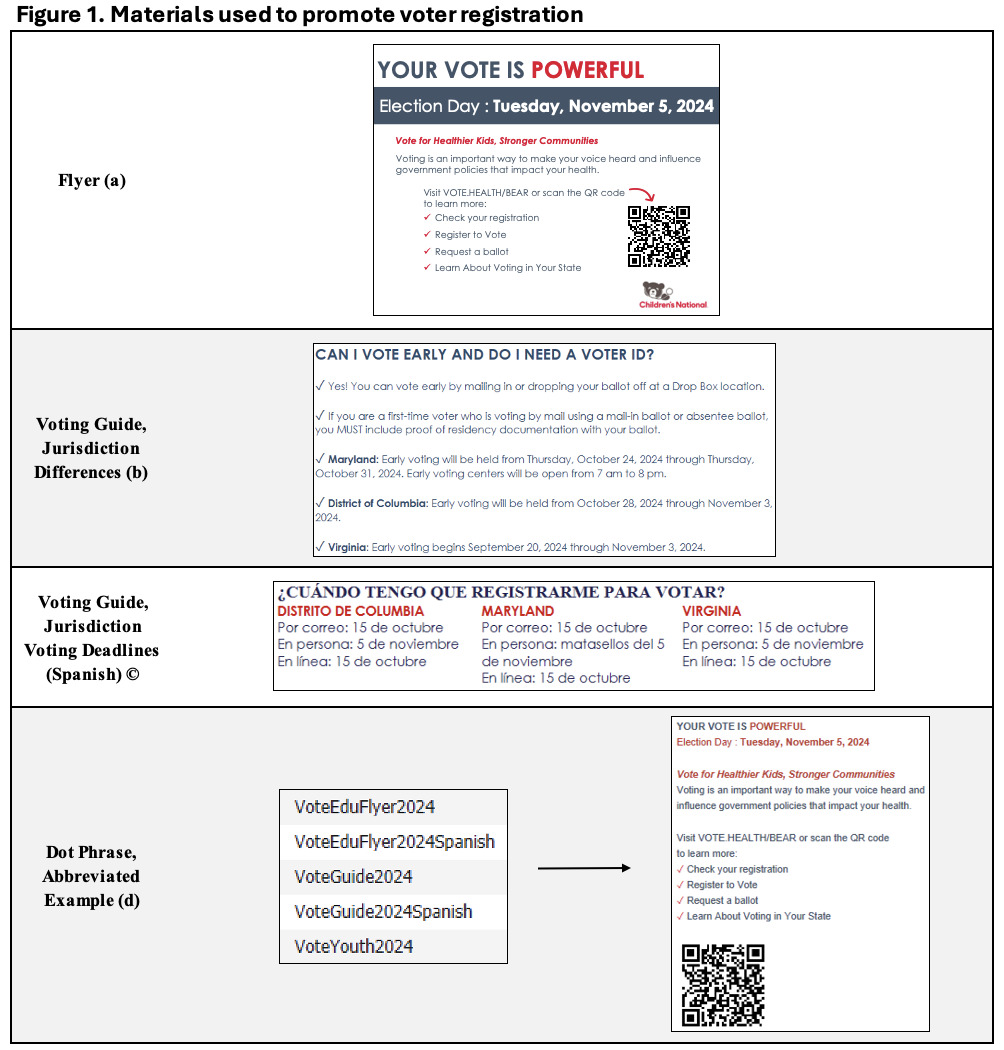
Flyers were created with institutional branding using the Vot-ER QR code and posted around the hospital and clinics in the outpatient setting (Figure 1a). Like the badges, we customized the flyers to our hospital system using the same QR code leading to the Vot-ER website.
-
Vot-ER provided us with custom phone background templates and web-conferencing (e.g., Zoom, Microsoft Teams) platform templates. Like with the badges and flyers, the virtual backgrounds included our unique Vot-ER QR code.
-
Dot phrases—text shortcuts that expand into pre-designed templates—were created within our hospital’s electronic medical record (EMR) system. Multiple dot phrases that expanded into several different voting guides were integrated into patient paperwork, such as hospitalization and emergency department discharge summaries. Guides were developed for adult caregivers and teenage patients (who may be eligible voters). Expanded guides for adult voters consisted of information about absentee voting, early voting, candidates, and registration deadlines (delineated by location between Washington, D.C., Virginia, and Maryland) (Figures 1b and 1c). The expanded guides for teenage patients relayed similar information, in addition to minimum age requirements and guidance on pre-registering to vote once the teens turn 18 years old. An abbreviated guide that relayed similar information as the QR codes was also developed (Figure 1d). The voting guide (teenager or adult, abbreviated or expanded) selected for inclusion in patient paperwork was at the discretion of the patient’s provider.
-
Hospital-wide newsletters, community town halls, and virtual meetings also were used to share voting information and materials.

Garner Departmental Support and Identify Champions for Voter Mobilization
Concurrent with our efforts to engage leadership and prepare campaign materials, we reached out for buy-in from division leaders (e.g., Division Chiefs) and to identify “champions” across the various clinical divisions. Champions were defined as advocates interested in our work who could lead and promote campaign efforts within their specific divisions. Champions were identified via word of mouth and email outreach to individuals who were known to have prior involvement in voting efforts or community engagement work. The divisions that agreed to engage in our voting campaign included but were not limited to: Graduate Medical Education (resident and fellow trainees), Division of Hospital Medicine, Division of Emergency Medicine, Division of Adolescent Medicine, Department of General and Community Pediatrics, and the Child Health Advocacy Institute. This greatly increased the reach of the campaign.
Champions were empowered to engage in voter registration efforts by using our materials and via their own individual efforts in their respective clinical and non-clinical locations. To capture the outcomes and feedback of our champions’ efforts in voter mobilization, we created and administered a post-implementation survey. We only surveyed champions, given their leadership role in the campaign and to reduce redundancy in responses.
ANALYSIS
To support our onsite voting campaign, a total of 375 Vot-ER badges were distributed to ten different sections of the hospital including the trainee (resident and fellow) physicians, specific departments, and the hospital’s advocacy institute. From summer 2024 to February 2025, our QR codes had 357 scans, leading to 103 “Voter Registration” clicks and 43 “Voter Readiness” clicks on the Vot-ER website.
We engaged 22 champions. Thirteen (out of 22, 59%) champions responded to the post-implementation survey administered between March 3, 2025 and March 17, 2025. In general, champions reported using the badges, flyers, and dot phrases in their respective departments and posting materials in highly trafficked patient and staff areas such as patient rooms and waiting rooms. Many division champions focused on directly engaging patients and families through clinicians wearing badges and asking about voter registration status. Champions also reported that non-clinical patient-facing staff such as registration personnel were essential to engagement efforts as they were able to pass out voter registration information and incorporate this work into their existing workflows. Some examples of the specific efforts made by our champions included:
-
One champion hosted a webinar for their team members—including nursing and front desk staff—during which they reviewed the available voting materials, voting deadlines, and general voting registration process. By providing an opportunity for clinical and non-clinical staff to learn more about the voting process, the webinar was thought to lead to better overall engagement in the voter registration efforts and to improve eligible voter engagement (as measured by our QR code data).
-
Another champion partnered with the District of Columbia Board of Elections to host a voter registration event at an ambulatory care site. Members of the District of Columbia Board of Elections were physically present to help with voter registration of eligible patients and families, as well as distribute voting information.
Champions also reported areas for improvement, such as difficulty integrating voter registration efforts into their busy clinical schedules. From a provider perspective, patient and staff interactions are often already limited due to busy clinical demands resulting in limited time to discuss voting. To overcome this, one champion recommended integrating voter registration into the existing workflow of the clinic as a whole instead of relying only on clinical staff. Formally engaging non-clinical staff (such as front desk staff) was thought to be beneficial, as voting information could be integrated into the overall processes that occur during a clinic or hospital stay. In the hospital setting, standardizing the inclusion of voting information into discharge paperwork was also thought to be a helpful strategy.
In addition, multiple champions recommended starting voter efforts earlier with an emphasis on annual local elections, not simply presidential election years. Overall, making these processes formalized, standardized, and automatic was thought to not only increase engagement but also reduce additional work for staff, making those efforts more effective and sustainable.
Throughout our voter education, mobilization, and registration campaign, we learned key lessons to support future efforts and hopefully help guide other institutions interested in adopting onsite voter campaigns.
LESSONS LEARNED
Work Closely with Hospital Leadership
Buy-in and support for voter registration efforts from hospital leadership is critical. Some expected challenges to institution-wide support may include financial constraints and apprehension related to potential partisanship and legality of the efforts. However, many materials are free or low-cost. And, more importantly, engaging in nonpartisan voting efforts in the healthcare setting is not only legal (Department of Justice 2024) but increasingly common (Grade et al. 2023; Martin et al. 2021).
As previously described, the National Voter Registration Act of 1993 established a legal basis for nonpartisan voting efforts in the healthcare space (Department of Justice 2024). However, large-scale voting efforts within hospital systems are a recent development and thus may not be a part of current hospital procedures. For partisanship concerns within health care settings, advocates can refer their leadership to the National Voter Registration Act and assure them that your campaign efforts will be conducted in a nonpartisan manner. Voter registration efforts also may not be included in existing hospital policy, so support from institutional leadership is critical for both approval and implementation. For example, leadership approval will likely be required to use staff time and engage the expertise of interpreter services or media/public relations team members. In our campaign, meeting with leadership early, building relationships, and referring to similar efforts at other institutions helped garner leadership approval.
If there are financial concerns, advocates may discuss options for materials that are free or available at a reduced cost. Hospital leadership will want to consider the financial investment including costs to purchase, design, and distribute materials, so be prepared by drafting and sharing your budget. When proposing your campaign plan, also consider that voter registration and education efforts may be considered a “community benefit,” which are activities that promote and enhance the health of a community. Community benefit is a basis for tax-exemption for nonprofit hospitals, making this an appealing aspect when garnering buy-in from leadership (Puro and Kelly 2022). In this regard, your campaign champions should consider tracking community-facing activities for required annual community benefit metric reporting.
While we did not face opposition or resistance from our leadership team for our voter registration campaign, engaging individuals at the executive level and within community relations will likely be essential and hopefully leads to buy-in and consistent support of these efforts.
Start Early to Maximize Efforts
Engaging hospital leadership, garnering support from various divisions, obtaining and developing materials, and creating a plan are all time-intensive activities.
Anticipate challenges with leadership buy-in, as efforts in a large healthcare system take time and energy that may require multiple meetings and reassessments. In our case, leadership buy-in was not a major challenge, but this should be expected to be a possible barrier when creating a timeline. Next, we garnered support from champions in departments across our inpatient and outpatient spaces, which we highly recommend to facilitate smoother and stronger voter registration efforts; however, this also takes time so be sure to build this into your plan.
In addition, requesting and creating materials (i.e., Vot-ER badges, customized institutional flyers) early on is critical to allow time for their optimal development, distribution, and utilization. Additionally, developing robust materials, especially in multiple languages and with information for different populations (by age, voting location, etc.), requires engagement with various partners and may take more time than anticipated. While we started these efforts six months prior to election day, some of our materials were available only shortly before the election, which likely diminished their effectiveness. The process of ordering materials, especially those that include customization to your specific healthcare system, may take a couple of months from ordering to delivery and, in our case, was one of our rate-limiting steps. As such, we recommend beginning at least 12 months in advance, especially if this is the first time your practice, institution, or healthcare system is engaging in a voter mobilization campaign.
Know Your Voters: Be aware of voting rules, regulations, and policies in various jurisdictions
To develop an effective voter registration campaign for a range of voters who may live in and across various districts and possibly multiple states, it is essential to understand each jurisdiction’s voting rules and regulations. Our efforts targeted eligible voters residing in three jurisdictions, one of which did not have statehood (Washington, D.C.). This required us to develop materials with information on all three jurisdictions’ voter registration deadlines and policies. So, be sure to consider the primary areas where your patient families and staff reside, since they could live outside of your state lines.
In addition, for staff members, consider if protected time to vote is provided. For example, two of our three target voting jurisdictions (Maryland and Washington, D.C.) have laws in place that allow two hours of paid time off to vote (Zebrowski 2024). About one-half of U.S. states allow paid or unpaid time off to vote, which is an important consideration for advocates when designing implementation strategies and engaging hospital leadership (AbsenceSoft 2024). Determining how this time-off policy applies to a variety of staff roles may be a key aspect to improving staff voting rates. Learn as much as you can about what would make it easier and more convenient for your physicians and staff to vote and see if you can help—this is an essential step not just in terms of increasing voter registration but creating an equitable environment.
Identify Champions across Inpatient and Outpatient Divisions
Many hospital systems have main hospital campuses and smaller hospitals or clinics that are spread across wide geographic areas (even across state lines, as in our case). Our efforts were supported by division leaders and champions within the hospital and within our outpatient spaces. While large hospitals tend to treat the largest number of patients and house the most employees, including outpatient settings in this work is critical for capturing even more eligible voters in these diverse settings. Having champions serve as point-people that lead and encourage efforts in their respective spaces is also key to harnessing more advocates and thus increasing voter registration. Division champions know their settings well and can determine which tools and methods of voter engagement are most likely to be effective based on their specific context. Champions also have connections to key personnel (e.g., other leaders in their divisions, non-clinical staff) to facilitate staff-facing (e.g., workshops) and patient-facing (e.g., flyers) voter registration efforts.
Involve Healthcare Professionals in Advocacy as Part of Their Lifelong Careers
Healthcare team members, including trainees, are often inherently health advocates and some suggest that advocacy is inherent to the identity and duty of a physician (A. P. Kelly and Wetherhorn 2020; Port and Joyce 2025; Stanicki et al. 2023). We know that our attending physicians increasingly participate in advocacy projects, and each year there are new trainees who want to engage in advocacy. Assigning them as leaders to help manage the voting campaign each year provides a sustainable approach, as well as offering our trainees advocacy experiences that can be carried forward into their careers. While you are unlikely to know how much your healthcare leadership, professionals, and staff or eligible voters among your patient population are aware of the connection between voting and more positive health outcomes, this may be a good time to educate and inspire them.
Engage Patients, Caregivers, Family Members, and Staff
The range of eligible voters that engage with a healthcare system, including personnel and patient families, provides experienced and aspiring advocates with a host of people to engage. More buy-in may be attained if the advocate communicates directly with an eligible voter—such as actively asking about voting within a patient encounter and then sharing voting resources. Staff who are planning to use active voter registration measures should develop a standardized plan to consistently engage all patients and families to ensure there is no perceived or true bias in how patients and families are approached. While more passive efforts, such as posting flyers and including voting guides in patient paperwork, may be easier for advocates to implement, it is challenging to measure their effectiveness. To better assess the impact of these different strategies, we suggest developing and distributing a survey to eligible voters at the end of the campaign to inquire about the effectiveness of your campaign efforts and gather feedback. Surveys can be coded for providers, non-clinical staff, patient families, etc.; having feedback about how this work was perceived will be helpful in refining your materials and activities more appropriately across groups for the next campaign.
As part of this process, as it is with most any effort within the healthcare system, it is important to understand the demographics of your patient population—if you serve a very diverse population, understanding more about who you serve at each location can be helpful in determining and implementing your plan as well as the materials and languages of those materials. Ultimately, we recommend using a variety of methods to reach the largest number of eligible voters and asking for feedback to make improvements as you go.
Choose a Sustainable Approach to Encourage Longevity
Building the initial foundation of a voter drive requires the most time and energy; however, this provides momentum for future efforts. Congressional elections take place every two years, general U.S. elections take place every four years, and many local and state elections occur annually. Setting the initial foundation for a voting campaign can serve as a guide for annual voter efforts that can be continuously augmented and revised. Advocates may also consider reserving higher intensity voter registration campaigns for major elections that occur every two to four years. This approach would allow for more time to plan and engage new advocates and new champions.
Times change and so do people. For hospital staff, there may be frequent turnover, especially at the start of a new calendar or academic year. Staff often move from other voting jurisdictions and thus require voter re-registration. In the pediatric space, patients turn 18 or legal voting age in the U.S. throughout the year; as such, there is benefit in continually engaging these newly eligible voters.
Voting is an important civic responsibility. Knowing that there also is a strong association between voting and positive health outcomes should be yet another motivating factor to vote. And by engaging in voter registration, health care systems can further their contribution to the overall health and wellness of their patient populations, providers and staff, and all of society.
To further our own work, we plan to continue to expand and amplify our advocacy efforts into more annual activities and augment our efforts by continuing to engage hospital leadership with the aim of reaching more champions in our inpatient and outpatient spaces.
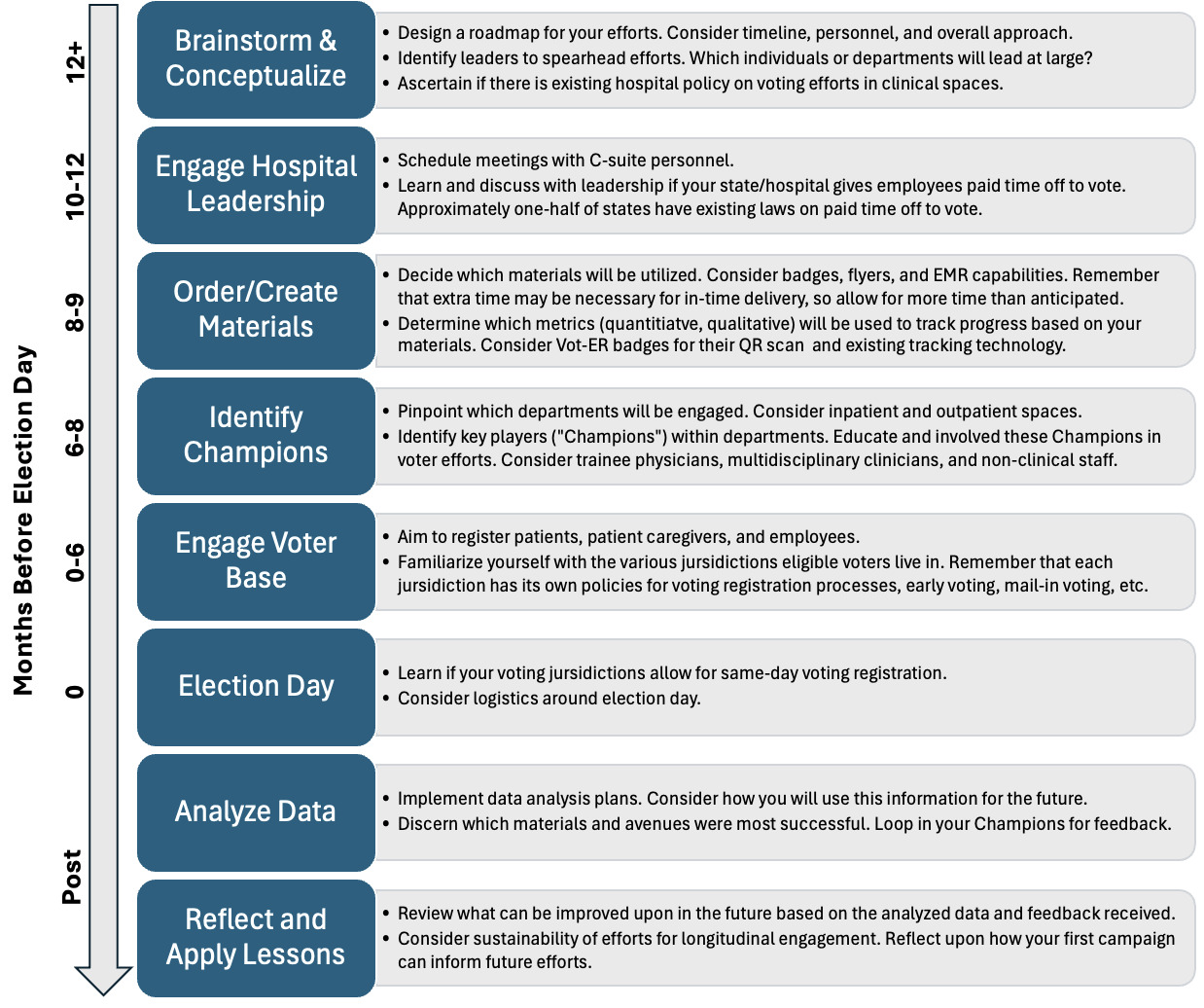
Here, we described our approach to a nonpartisan voter education, mobilization, and registration campaign in a large pediatric healthcare system, and provided key takeaways and strategies to build a sustainable voter registration drive. This advocacy case study provides one example of some of the tools and strategies a hospital system can use. We recognize there are nuances across systems and voting jurisdictions, but we hope our approach, materials, and lessons learned can inform others in designing and implementing their own advocacy efforts to support voting and improve health for all. Drawing on these experiences, we developed a recommended-step-by-step framework (Figure 2) to guide implementation of a voter registration campaign at your health care institution.

Acknowledgements
Thank you to the institutional leaders and division champions who made this work possible. Thank you to the Vot-ER and American Academy of Pediatrics teams who have dedicated great time and energy to developing non-partisan healthcare-specific voter engagement materials. Thank you to the patients, families, and staff who engaged in these conversations, and to our community members who are registered, active voters.
Author Contributions
All authors made substantial contributions to the conception and design of the work; the acquisition, analysis, and interpretation of data; drafted and reviewed the work for important intellectual content; provided final approval of the manuscript to be published; and agreed to be accountable for all aspects of the work.
Funding/Support
The authors have no funding to report.
Abbreviations
U.S., United States; D.C., District of Columbia; AMA, American Medical Association; AAP, American Academy of Pediatrics; QR, Quick Response; EHR, electronic health record