
INTRODUCTION
Medical educators have a responsibility to develop future physicians poised to improve care for all patients including historically marginalized populations, or populations that have been excluded from full access to resources, rights, and opportunities (Lapite et al. 2021; Metzl and Hansen 2014; Smedley et al. 2003). However, because medical curriculum has been traditionally based on dominant culture—or the prevailing cultural norms and practices that are often derived from groups in power—without careful attention, it may inadvertently perpetuate health inequities (MacLeod 2011; Phillips 1997; Bickel 2001; Beagan 2005). Unfortunately, many medical schools continue to have curricula centered on whiteness, meaning that the preponderance of teachings are based on studies of predominantly white patient populations. Meanwhile, issues that primarily affect people of color are underrepresented, and clinical cases that are meant to teach students how to care for their patients continue to contain stigmatizing or biased language (MacLeod 2011; Phillips 1997; Bickel 2001; Beagan 2005; Martin et al. 2016; Merk et al. 2024; Lubarsky et al. 2023; Gingell and Bergemann 2022).
Case-based learning is a pedagogical approach used to teach learners key clinical features and develop medical decision-making skills through the use of fictionalized descriptions of patients (“cases”). Case-based learning is popular in medical education because it closely matches the clinical practice environment, promoting diagnostic reasoning in a realistic format (Varma et al. 2025; McLean 2016). Additionally, it encourages active learning, supports teamwork and collaboration, and can be adapted for all stages of learning throughout medical education (Thistlethwaite et al. 2012). Case writers are generally faculty who develop curricular cases for teaching their content areas of expertise, and many develop cases by drawing on a mix of their own clinical experiences, diagnostic reasoning, and basic science knowledge. Though central to medical education, case-based learning is particularly susceptible to stereotyping and stigmatizing language (Mosley et al. 2021).
Stigmatizing and biased language can take various forms including stereotypes (e.g., personifying people experiencing poverty as unmotivated), negative labels (e.g., designating patients as “noncompliant”), and framing that reinforces social exclusion (e.g., using the word “illegal” rather than “undocumented” to describe a person) (Goddu et al. 2018; Sun et al. 2022). Including such language in medical teaching cases may increase the likelihood that learners, regardless of their own identities, will use this same language in their future clinical practice, and may increase learners’ use of microaggressions—unintentional comments that convey bias or reinforce stereotypes (Bergemann et al. 2025). The normalization of microaggressions is particularly harmful, as they have been shown to alienate minoritized patients (treated as distinct from or less than the dominant population), decrease their trust in healthcare, and prevent them from seeking care (Goddu et al. 2018).
Bias reflected in curricular materials may also teach learners to misattribute risk factors to patient characteristics rather than systemic factors that impede access to care, factors which include discrimination and bias in the health-care setting. This misattribution may prevent learners from adequately understanding and addressing barriers to health and ultimately may perpetuate health disparities (Gingell and Bergemann 2022; Tsai et al. 2021). Because medical cases play a critical role in teaching students how to care for future patients, the content and language of these cases should be closely considered.
Often, race and/or sexual orientation are not mentioned within clinical cases unless the patient is from a minoritized background. This practice can sustain the prevailing societal (and student) perception of dominant culture as “normal” (Martin et al. 2016; Bowden et al. 2021; Hariharan et al. 2022). Conversely, when a patient’s race is mentioned in a case, it is frequently done so in ways that perpetuate stigma about historically marginalized communities (e.g., Latine patients are routinely described as undocumented, non-Hispanic Black individuals are poor or uneducated, etc.), which can foster negative attitudes toward those patients (and perhaps other students), drive providers to fail to address systemic causes of disease among their patients, and provide learners with inadequate instruction about how to care for patients who identify with marginalized groups (MacLeod 2011; Phillips 1997; Bickel 2001; Beagan 2005). Such stigmatizing language has been shown to generate negative attitudes towards patients and negatively impact care decisions, and, when it is reflected in provider behaviors, can reduce trust and discourage treatment seeking among patients (Dale et al. 2019). Alternatively, when diverse patient populations are not represented in cases or other teaching materials, the medical curriculum can fail to teach students how to address health conditions in those groups. For example, if dermatologic teaching materials do not contain images of conditions on Black skin, students may not be able to identify certain diseases in Black patients. Or, if students are not exposed to gender-diverse patient cases, they may not adequately learn how to have meaningful conversations with these patients or create inclusive healthcare environments.
The underrepresentation or misrepresentation of minoritized groups in case-based learning not only affects patients, but can impact medical students who identify as being from these same groups by decreasing their self-esteem and performance and increasing anxiety and depression (Bandyopadhyay et al. 2022; Nadal et al. 2014; Lett et al. 2020). Exposure to stigmatizing representation of their own identities in cases has been shown to lead learners to “having to disidentify themselves to maintain self-esteem in the face of judgement” (Bandyopadhyay et al. 2022, 991), thus negatively impacting professional identity formation, particularly for students from underrepresented backgrounds (Bandyopadhyay et al. 2022).
During a recent curriculum reform process at the University of Colorado School of Medicine, various faculty and students raised concerns about stigmatizing language, stereotyping, and lack of diversity in patient cases. To better understand and address these concerns, we aimed to create a case review process—a systematic method to review, identify, and suggest changes to all cases within the medical school curriculum—with the goals of removing stigmatizing and stereotypical language, increasing representation of diverse patient populations, and educating faculty and staff about inclusion in curricular materials. An underlying motivation for the case review was to decrease harm to patients and learners by ensuring that patient cases represent diverse patient populations and do so in a way that does not inadvertently demonstrate stigma or stereotype. We sought to make these changes by focusing on patient-centered language, or language that prioritizes respect and individual preferences, and by including contextual elements to emphasize the structural factors that lead to health inequities.
Case Review Process
Objectives
The objectives of the case review initiative were to: 1) develop a case writing template for new case development; 2) form a case review committee of students and faculty; 3) establish a thorough case review process with a focus on addressing stigma and stereotypes; and 4) conduct a comprehensive curriculum-level review to assess representation of diverse populations across all teaching cases used in the medical school curricula.
Setting
The case review process was developed at the University of Colorado School of Medicine, a public medical school located on the Anschutz Medical Campus in Aurora, CO, within the Denver-Aurora metropolitan area. The school delivers undergraduate and graduate medical education in an urban, academic health-sciences setting with affiliated tertiary-care hospitals. The regional population of Aurora is 46% non-Hispanic white, 31% Hispanic or Latino, 16% non-Hispanic Black, and 6% Asian, and less than 1% Native Hawaiian/Pacific Islander. Eighteen percent of the population of Aurora identifies as more than one race (U.S. Census Bureau, n.d.). The self-reported demographic characteristics of the student body enrolled in the School of Medicine show that it is composed of approximately 63% women, 36% men, and 1% unknown (University of Colorado Denver 2023). The racial breakdown reflects 60% white, 14% Asian American, 13% Hispanic, 4% African American/Black, 1% Native American, 3% International, and 4% unknown (University of Colorado Denver, Office of Institutional Research and Effectiveness, n.d.). Faculty demographics are not published for the medical school specifically, but across campus approximately 66% of faculty identify as women and 16% as people of color.
Case Writing Template
A case writing template was developed in collaboration with faculty and students who had previously expressed interest in addressing stigma in curricular cases. A small group of educators developed the initial draft and disseminated it among all student affinity groups to gather feedback and broader perspectives. The core tenets of the template (see Supplementary Materials) were derived from existing guidelines published by the Columbia University School of Medicine for case-based learning (Columbia University Irving Medical Center, n.d.). These were then expanded to prioritize person-first language, add demographic and contextual categories (e.g. family structure, language, spiritual history, environment), and require an explicit statement of race, ethnicity, and gender identity—to avoid the default assumption of whiteness and cisgender identity (Columbia University Irving Medical Center, n.d.).
All faculty case writers received training on using the template, including the rationale behind its use, and had access to the template when developing their course materials. After the training session, members of the training team met with case writers in small groups to answer any questions. Use of the case writing template was required for all teaching cases across the four-year curriculum that were longer than one paragraph. The paragraph cutoff was selected because it provided sufficient space to incorporate essential contextual elements without adding significant length. Case writers were instructed to use the case writing template to guide the creation or adjustment of cases and submit them to the case review committee for formal review.
Case Review Committee
A case review committee was formed to read all curricular cases and provide suggestions to case writers. Staff and faculty with experience in health equity in medical education were invited to the committee by a group of faculty members selected to oversee the review process. Invitations were also extended to all student affinity groups on campus (e.g., religious communities, White Coats for Black Lives, Physicians for Human Rights, and specialty-interest groups); any interested student was invited to join. The final case review committee was composed of 12 faculty and 12 students representing diverse backgrounds. Case review committee members were provided with a letter of gratitude for their service that could be applied towards a residency application and/or promotion.
All committee members participated in a standard-setting training to ensure consistency and to establish shared definitions for stigmatizing or stereotyping language, as described below. This training consisted of small-group sessions where committee members and faculty reviewed two cases that contained different examples of stereotypes or bias. Through collaborative discussion, the group came to consensus about what constituted stigma, stereotype, and bias in the written cases and then set standards for how to assess the cases across those categories.
The standard-setting process was guided primarily by the American Medical Association and the Association of American Medical Colleges’ “Advancing Health Equity” guide on equity-focused language (American Medical Association and Association of American Medical Colleges 2021). These guidelines were developed to center people’s lived experiences without the use of language that reinforces labels, or that objectifies, stigmatizes, or marginalizes individuals and populations.
Case Review Procedure
Members of the case review committee were assigned to review each case in pairs to attempt to achieve diverse perspectives and to maintain process reliability. Committee members were instructed to make suggestions only on biased or stigmatizing language and not to comment on other aspects of the case.
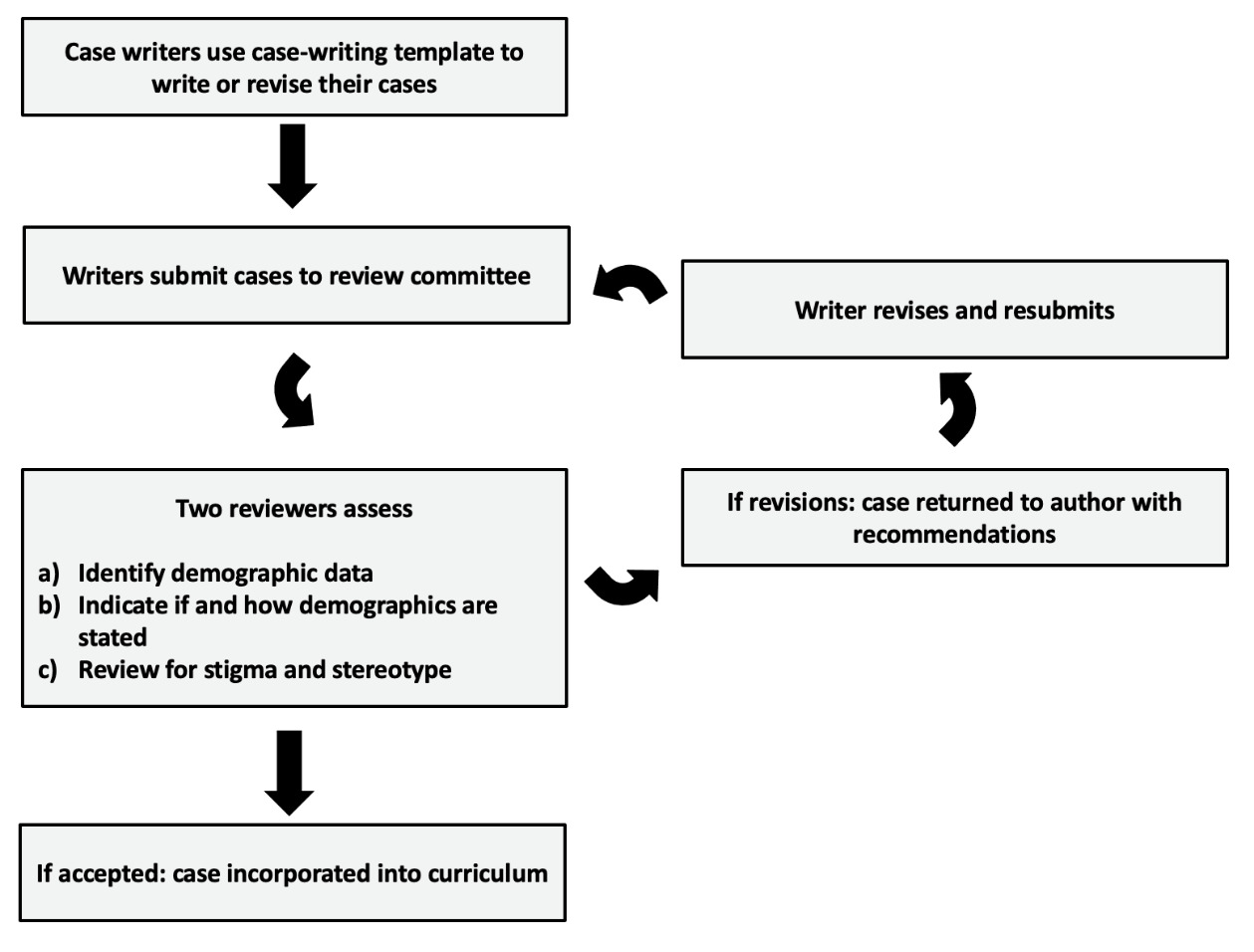
The case review procedure (Figure 1) progressed as follows: 1) A pair of committee members is assigned a submitted case for review; they collaboratively review the case for stigmatizing language as described in Table 1; 2) the pair makes a recommendation of no revisions, minor revisions, or major revisions; 3) If revisions are necessary, the case is returned to the case writer, who is asked to assess the suggested revisions and revise the case and/or refute the suggested revisions; 4) The case writer resubmits the revised case to the committee; 5) The committee re-reviews the revised case and makes another recommendation until it is accepted with no revisions.
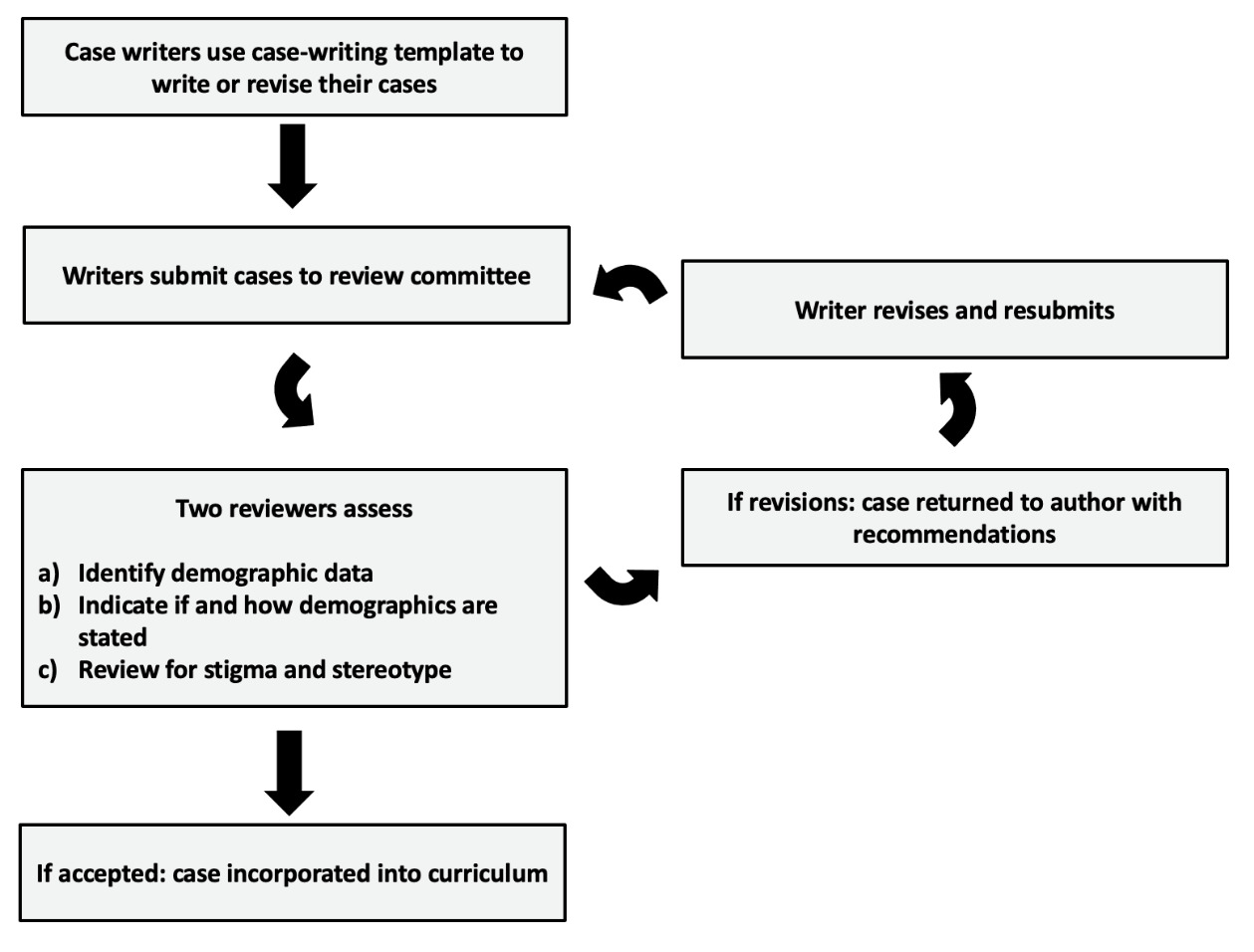
Cases that needed revisions—minor or major—were either identified as having stigmatizing, biased, or stereotyped language, as not explicitly identifying demographics (age, gender identity, race, ethnicity, etc.), or as not adequately providing context in the history of present illness (HPI) or context subheading. Contextual information had to be presented from the patient’s perspective (e.g., “patient reports they are homeless” versus “patient appears to be homeless”).
For each case, the two assigned committee members conducted an asynchronous, independent review of the case and came to consensus about what, if any, changes should be suggested. They suggested edits using the comments and track changes features on a shared Microsoft Word document. Based on the number and extent of the changes suggested, they recommended no revisions, minor revisions, or major revisions as described above.
Cases requiring revision were returned to case writers, who could then discuss proposed changes with the case reviewers and/or make modifications. After modified cases were submitted, they were re-reviewed by the same committee members until accepted without modification. Some examples of what qualified for major and minor revisions can be found in Table 2.
Once a case is finalized and accepted, it is incorporated into the curriculum. Once a case is incorporated, every medical student (approximately 180 students per class) uses the case when they reach the part of the curriculum for which it is relevant. Over the four-year curriculum, a student could expect to see all the cases as part of their medical education.
Curriculum-level demographic review
As cases were submitted, case writers were tasked with a) identifying key case demographic data, such as gender identity, race, ethnicity, socioeconomic status, and other relevant characteristics in the HPI or context subheading (see Supplemental Materials) to support tracking of identities included in all cases across the curriculum, and b) indicating whether demographic data were explicitly stated, presumed, or not stated within the submitted case.
After most cases were approved for addition to the curriculum, the total distribution of case demographics across the curriculum was analyzed to ensure inclusion of multiple dimensions of diversity, including race, ethnicity, gender identity, sexual identity, urban/rural residence, veteran status, socioeconomic status, and ability status. To achieve this, overseeing faculty reviewed all identities represented in submitted cases and identified which key identities were omitted at the broader curriculum level. For example, initial curriculum-level review revealed a lack of representation of transgender individuals across the curriculum. To address this gap, selected case writers were asked to adapt cases accordingly, without affecting the educational content of the case.
The original cases, revised cases, and demographic information included in each case were tracked for future review and analysis.
RESULTS
Of the 133 submitted cases, 40 cases (30.1%) were accepted with no revisions, 86 (64.7%) required minor revisions, and 7 (5.3%) required major revisions. Most cases required two rounds of revisions. In total, 62 cases (46.6%) were determined to contain stigmatizing language and 34 cases (25.6%) included stereotypical or biased content. On average, the committee provided initial reviews within one week. All 133 cases were finalized for addition to the curriculum.
Most (82.7%, n=110) of the originally submitted cases included gender identity (majority cisgender), but did not specify race, ethnicity, or sexual orientation despite prompts in the case template (Table 3). Among cases in which race was specified, 48% (n=14) of patients were identified as non-Hispanic white; the remainder were identified as Hispanic (21%, n=6), non-Hispanic Black (17%, n=5), “non-white” (7%, n=2), and non-Hispanic Asian (7%, n=2). When gender was specified, 94% were identified as cisgender (n=103). For cases when sexual orientation was specified, 78% (n=39) were described as straight, 12% (n=6) as bisexual, 4% (n=2) as gay, 4% (n=2) as lesbian, and 2% (n=1) as asexual.
In many of the cases in which race, ethnicity, or gender identity was not explicitly stated, case writers submitted case demographics that aligned with the dominant culture (e.g., white, cisgender, straight, English-speaking) without explicitly stating these identities in the case. For example, one case included information about a cisgender white patient in the demographic questionnaire, though the actual case description/narrative did not include such identifying information. During case review, it was determined that some cases reflected presumed identities based on inappropriate demographic indicators (e.g., one case identified a patient as straight solely because the case stated that the patient was married).
The curriculum-level demographic review process revealed underrepresented identities and stereotypical examples without corresponding counter-stereotype examples (examples that intentionally go against common stereotypes). Because no transgender men or Indigenous identities were represented in the original case materials, cases were adapted to include these identities. Other cases were revised by case writers to include counter-stereotypes such as male nurse, Black female Chief Executive Officer, among others. After a complete review of cases across the medical school curriculum, the demographics in five (3.8%) cases were changed to improve representation and inclusion of minoritized identities as described above. When identities were not specified at all in cases submitted for review, case writers were asked to provide this information in the case. Committee reviewers guided case writers to add demographics so that the demographics of the totality of cases would match those of the U.S., to best prepare learners to care for a U.S. population (assuming most learners would ultimately practice in the U.S.).
DISCUSSION
At the University of Colorado School of Medicine, we developed and implemented a case review system to disrupt the stereotypes and stigma frequently present in clinical cases, which are widely used learning materials across the medical education curriculum. The major impacts of our intervention were the revision of multiple cases, leading to the removal of stereotypical and stigmatizing language, education of case writers and reviewers, and the addition of demographic identities that were not previously described in cases presented for inclusion in the curriculum.
Overall, the review process was well received by case writers as determined through informal feedback. Although a few faculty members questioned whether this was needed and raised concerns about turnaround time, the committee overall did not face significant opposition to suggested revisions and aimed to minimize disruption to case writers’ workflow by having a quick turnaround. When the committee recommended changes, the process focused on explaining to case writers why changes were suggested to incorporate an element of education into the review process.
Through the case review process, we identified two patterns of concern: a failure to specify demographic characteristics and the use of stigmatizing language. Both patterns were initial motivations to develop the process and provided validation for the work. More specifically, we found that many cases lacked explicit information about race, ethnicity, and gender identity despite the explicit requirements outlined in the case writing template. We theorize that the omission of identifying information in cases reflects a range of reasons, including case writer apprehension, lack of knowledge, and assumptions of majority identity—again, these are some of the key issues the case review process was developed to identify and address. Previous studies have discussed the apprehension, fear, and confusion surrounding discussions of race, gender, and sexuality (Sue 2013). Cases may also have had missing demographic identifiers because case writers assumed the dominant race, gender, and sexual orientation (white, cisgender, and straight) were implied if they were not explicitly stated. Identifying and addressing these assumptions are critical because these choices establish an ingroup/outgroup dynamic, which could promote the perception that identities outside the dominant culture are deviations (Knowles and Peng 2005). Previous studies have shown that people are less likely to express empathy towards those in an outgroup, further emphasizing that the perpetuation of this ingroup/outgroup distinction is likely detrimental to patients as well as students, educators, and healthcare professionals at large (Bowden et al. 2021; Vanman 2016).
The case writing review process was intentionally designed to be educational by providing clarification, guidance, and additional information to support faculty member case writers in successfully including demographic identifiers in their cases. However, to further strengthen these efforts, additional faculty development on the case template requirements along with case writing workshops will be needed to increase inclusion and reduce biased, stereotypical, and stigmatizing language in clinical cases in the future.
The findings of our case review process closely reflect those of previously published related reports, especially in revealing the overrepresentation of majority identities and underrepresentation of minority identities, the assumption of majority identities when demographics are not explicitly stated, and the presence of stereotypes within cases (Bowden et al. 2021; Finucane and Carrese 1990; Gu et al. 2023; Seymour et al. 2023). Although our case review process reflects previous studies in terms of its findings, it differed in structure. Previous case review studies often implemented part but not all of the components of our case review process (writing template, review of cases, demographic review) (MacLeod 2011). Other studies often had the primary goal of analyzing demographics in their current cases (Bowden et al. 2021; Lee et al. 2022; Krishnan et al. 2019). However, no reports included a focus on identifying and revising problematic cases, increasing the range of diverse identities, and reducing bias and stereotypes, all while also involving and educating case writers, students, and faculty. By including these elements as part of our study, our findings expand on what has been published on this topic to date.
Our case review process did have several limitations. While we believe that all the elements of our case review process (case writing template, case review committee and process, curriculum-level demographic review) were necessary to achieve our stated goals, some elements could have been improved upon. Although faculty were provided with the case review template, many cases still required revision. Therefore, case review was still necessary to ensure that cases included all required demographic information and did not include stereotypes, stigmatizing language, etc. Without the case review template, we suspect that even more additions and revisions would have been needed. However, based on feedback from case writers, revising the template to provide additional clarity, and providing more robust faculty training on both using the template and identifying bias and stereotypes could further streamline the process and limit the number of cases that require revision. Although the global review of demographics across all cases only resulted in minor changes, we believe this is also a necessary component of the process as these minor changes are essential to achieve broad representation. While the case review committee consisted of volunteer students and faculty, we hope to be able to provide compensation for case review in the future. Ideally, the committee would be able to conduct a case review process regularly, as the curriculum continues to change. In the future, the review process should include cases shorter than one paragraph, such as those included in exams, because these are frequently used in the curriculum and, though short, still may include stereotypes and bias.
We predict that the revised clinical cases will help to reduce the introduction of bias in our medical education curriculum, though we have yet to investigate the full impact of these curricular changes on students and faculty. Formal evaluation measures, such as surveys of faculty knowledge and attitudes, student sense of belonging, broad curricular representation of diverse identities, and clinical application (e.g., student-written documentation), should be implemented in the near future. One anticipated source of student feedback will be the annual, nationally recognized Association of American Medical Colleges graduation questionnaire, with a specific focus on questions related to student preparedness to care for patients from diverse backgrounds, student experiences with mistreatment, and the school’s commitment to respecting diversity. Students also have access to a real-time feedback form throughout their enrollment, which provides a way to submit feedback on any aspect of the curriculum—including patient cases—at any time. To further assess the impact of the case review process, we could also compare historical real-time feedback with real-time feedback gathered after the implementation of the case review process.
Evaluating language via a case review process has the potential to decrease bias and stereotypes in educational materials, which may reduce the transmission of bias and stereotypes to future physicians and help to mitigate biased interactions between healthcare professionals and patients in the clinical space. Thus, we believe a case review process should be considered for all health professions educational programs. To advance this innovation, programs must advocate to secure buy-in from key faculty and curricular leadership. Such advocacy should focus on accuracy and quality of cases, meeting accreditation expectations, clinical realism, and/or standardization across cases. As our experience and example highlight, to create a successful process, programs should develop clear guidelines and procedures to identify, review, and track case submissions, revisions, and feedback. Programs will also need to consider available time and resources when deciding when curriculum-level case demographic changes would best support student learning.
More broadly, this work highlights the importance of sustained advocacy within medical education to ensure that curricular materials, institutional policies, and learning environments promote equity for both learners and patients. Embedding equity-focused review processes into routine curricular oversight represents an important next step toward addressing structural racism in medical education.
Acknowledgements
We would like to thank all the people who made the case review process possible: Katlynn Adkins, Christy Angerhofer, Joshua Blum, Chloe Briney, Samantha Conner, Vaquero Cooper, Ashley Curry, Mary Degroote, Michele Doucette (posthumously), Eric Eide, Ephrat Fisseha, Anne Frank, Brandi Freeman, Holly Fussner, Mackenzie Garcia, Sarah Groover, Lauren Grossman, Troy Kincaid, Abigail Leibowitz, Helen Macfarlane, Adom Netsanet, Sarah Nodine, Karen Orjuela, Amira Otmane, Margaret Tomcho, Sarah Vangi, Shanta Zimmer. We gratefully acknowledge the senior clinicians/educators who contributed the fictionalized cases and granted permission for their publication.
Funding/Support
The authors have no funding source to report.
Conflict of Interest Disclosures
The authors report no disclosures.
Ethical Approval
Not applicable
Disclaimers
Not applicable
Previous presentations
None
Author bios
Micaela Roy, MD is a medical resident at the University of Washington School of Medicine, Seattle, WA.
Kristin Furfari, MD, MS is an Associate Professor in the Division of Hospital Medicine at the University of Colorado School of Medicine, Aurora, CO.
Rita S. Lee, MD is a Professor of General Internal Medicine at the University of Colorado School of Medicine, Aurora, CO.