
INTRODUCTION
One primary role of a pediatrician is to advocate for child health alongside their daily clinical practice (Misra and McGee 2024). In 2001, the Accreditation Council of Graduate Medical Education (ACGME) first recognized the importance of advocacy in pediatric training. These guidelines required educational experiences to prepare physicians for patient- and community-level advocacy, including the ability to recognize and respond to structural, social, and environmental conditions that may affect a patient’s health outcomes (Howell et al. 2019). Since February 2024, the ACGME has further emphasized that pediatric trainees should have “a minimum of 40 weeks of primarily ambulatory care experiences, including elements of community pediatrics and child advocacy,” which broadly encompass exposure to social justice and resource access that regularly impact pediatric populations (Accreditation Council for Graduate Medical Education (ACGME) 2025). Recent studies have shown that formal advocacy education during medical training positively correlates with practicing pediatricians engaging in advocacy activities to support children’s health, offering the potential to create lasting and widespread impact on child health and healthcare disparities (Dodson et al. 2020; Risney et al. 2023).
In pediatrics, patient advocacy can be defined as the promotion of policies and practices that protect and improve children’s health by acting on behalf of patients to ensure healthy outcomes and quality care, and by addressing healthcare disparities (Nsiah et al. 2019). This can take place on multiple levels—from individual patient interactions focused on encouraging the development of healthy habits to broader systemic efforts aimed at improving healthcare access and quality. For example, this may include helping families connect to programs such as Supplemental Nutrition Assistance Program (SNAP) and Women, Infants, and Children (WIC), as well as partnering with local community resources like food banks that can provide families with direct assistance (Hubinette et al. 2017). Given historical and systemic vulnerabilities of pediatric populations, particularly among those living in underserved communities, advocacy is an essential skill for pediatricians.
One hurdle to integrating advocacy education into pediatric residency training is the divergent training methods required to teach and develop these skills. In pediatric residency programs, conventional training focuses on identifying the causes, symptoms, and treatments of illness. As more is understood about the social, economic and environmental drivers of health, however, programs increasingly recognize that training must adjust to include recognition and evaluation of these nonclinical elements. To engage in effective patient and population-level advocacy, pediatric trainees must look to expand their skillset using educational tools not included in traditional curricula (Magnan 2017).
Narrative medicine (NM) is one such educational tool. As a sub-discipline of the medical humanities, narrative medicine aims to better understand the human aspects of care by combining medical education with the study of literature, ethics, history, and other disciplines. Within that framework, NM training prioritizes empathy, critical thinking, and ethical reflection in healthcare settings (Charon 2001). The practice encourages a patient-centered approach that considers the patient’s personal values, experiences, and context. The NM approach can then foster narrative competence, or the ability to perceive, interpret and act on the stories of others, among health care providers. This is done by cultivating “attention, representation, and affiliation,” ultimately leading to a deeper understanding of patient experiences and challenges and bringing deeper alignment with the core components of patient advocacy (Zhao et al. 2023; Shapiro and Rucker 2003).
In 2017, the pediatric residency program at Baylor College of Medicine established a track called Primary Care Leaders Evaluating and Addressing Disparities (LEAD) that trains residents to provide primary care to patients with medical complexities. This patient population includes those living in underserved communities with inequitable access to healthcare and facing financial or immigration status-related barriers. Considering the intricate and systemic issues involved with providing access to this type of specialized care, this track helps trainees not only meet an essential need in the community but learn how to advocate for policies that can help to lessen their patients’ particular health-related challenges. Integrating NM into the LEAD track provides a novel way to help residents develop the advocacy skills necessary to amplify patient voices and, ultimately, drive meaningful healthcare reform.
To better understand the effectiveness and impact of NM training in developing trainees’ advocacy skills, we aimed to gather the insights of LEAD program graduates. We hypothesized that the LEAD program’s incorporation of NM skills would improve trainees’ perception of their ability to listen attentively, contextualize and sympathize with patient experiences, and advocate effectively on their patients’ behalf.
METHODS
LEAD Program Participants and Design
Introduced in 2017, the LEAD track is a specialized pathway within the pediatric residency program at Baylor College of Medicine. The three-year track accepts up to four pediatric residents per year. Candidates apply separately for this track, attracting those with a strong interest in providing primary care for underserved communities and engaging in advocacy. In 2020, the LEAD track had its first graduating class. The LEAD track curriculum is ACGME compliant (Accreditation Council for Graduate Medical Education (ACGME) 2025).
Compared to their co-trainees, residents accepted into the LEAD track receive greater exposure to primary care along with a stronger emphasis on outpatient specialty care. For example, LEAD residents complete specific rotations caring for refugee and immigrant communities. The track partners with community-based service providers to offer residents real-world opportunities to gain a deeper understanding of the unique challenges these communities face, with the hope that they will use this knowledge to drive advocacy efforts to expand access to care and narrow health disparities for these populations. To further this aspect of their training, LEAD residents attend a lecture series and evening seminars focused on developing local and state advocacy skills, such as crafting an elevator speech and visiting the State Capitol during session to meet with state representatives.
The NM component of the LEAD track involves engaging residents in activities to help them cultivate empathy during patient encounters, and sharing their insights with their peers by means of reflective writing exercises and small group discussions. They also learn effective storytelling skills that they can apply when engaging in legislative advocacy during visits with legislators or when writing and publishing articles to advocate for issues and policies that affect their patients. Overall, the NM training component provides structured time for residents to reflect on, engage with, and emotionally process patients’ and families’ experiences and stories alongside their fellow trainees.
Study Participants and Design
Study participants were recruited using a purposive criterion-based sampling method. LEAD program graduates (n=15) who completed their residency training by June 30, 2023 were invited by email to participate. Email correspondence contained (a) an introduction from the researchers, (b) an overview of the study and why it was being conducted, and (c) why the participant was invited and what they could expect if they agreed to be interviewed. After responding and agreeing to participate, participants were asked to provide written informed consent to audio-recording of the interviews and transcribing the transcripts.
The interview guide was created to contain a mix of open-ended and Likert scale questions. Interview questions went through multiple iterations to increase understanding and reduce the incidence of potential leading questions; the final guide did not undergo additional pilot testing.
During the interviews, participants were asked 11 open-ended questions (Table 1) regarding the NM component of their training to ascertain what effects it might have had on their personal and professional experiences of providing patient care. All interviews followed a consistent structure, with questions asked in the same order across participants. Each interview lasted approximately 45 minutes. No additional prompts were given to influence or modify responses after participants answered the original questions. Interviews were conducted by a research team member (NR) who was not involved in the LEAD track to minimize bias. All interviews were audio recorded and transcribed using the software platform Zoom (Version 5.17.0) and its auto-transcription feature before being analyzed.
Transcripts were anonymized and coded by number prior to analysis. Two researchers (AR, DPM) independently conducted manual thematic analysis of each transcript using an inductive approach; these researchers were not involved in the interviews to further decrease bias (Thomas 2006). Researchers utilized constant comparative methods to refine codes until themes emerged; coding continued until thematic saturation was achieved or until additional interviews did not yield new themes or unique responses (Clarke and Braun 2016). No repeated interviews were performed, and transcripts were not shared with the participants for comment and/or correction. Results are reported in adherence to the COnsolidated criteria for REporting Qualitative research (COREQ) (Tong et al. 2007).
Participants also completed a short survey in response to eight statements on a Likert scale (Table 1) to add a quantitative component to support the qualitative findings with measurable data. Survey statements were structured to elicit the LEAD graduates’ perceived impact of the NM training and sense of its effectiveness in instilling advocacy skills and values. The survey was administered verbally; participants were asked to respond with a number between 1–5 on a Likert scale that corresponded to statements of Strongly Disagree, Disagree, Neutral, Agree, and Strongly Agree. Each item was analyzed separately, and item responses were averaged to create a composite score.
RESULTS
Out of the 15 LEAD program graduates contacted for participation in the study, five were unable to be reached via email or telephone and the other 10 (66.7%) responded and consented to participate (n=10).
Thematic analysis of their interview transcripts revealed three consistent themes. Residents associated their NM experience in the LEAD track to: (1) an enhanced ability to connect with and advocate for patients, (2) an improved ability to put more effort and intention into patient interactions throughout a workday, and (3) a new ability to self-reflect on patient encounters and grow as a physician while mitigating the risk of burnout. Several participants also expressed the perception that the addition of NM to their advocacy training ultimately led to better patient outcomes, which they attributed to improved listening skills that helped them treat their patients more holistically. Table 2 includes the identified themes and corresponding quotes from the interviews.
LEAD graduates also reported that they developed a more nuanced approach to advocacy during their time in the LEAD track, enabling them to translate patient stories into meaningful action later on. Many also reported that their NM training provided them with concrete tools, like the ability to create a safe space and help families craft their own stories that they could then apply to community and legislative advocacy efforts (Table 2).
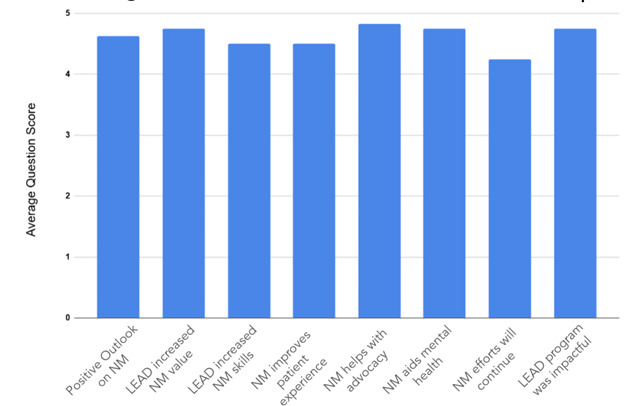
Residents generally responded positively to the Likert-scale statements, with most agreeing or strongly agreeing (a rating of 4-5) with all statements (Figure 1). Only one interviewee expressed a disagreement, specifically with the statement, “You will continue to use narrative medicine for the foreseeable future of your practice,” indicating they did not plan on continuing to use NM efforts in future practice.
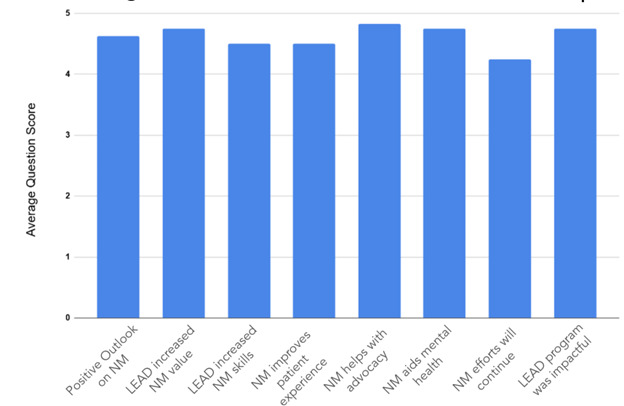
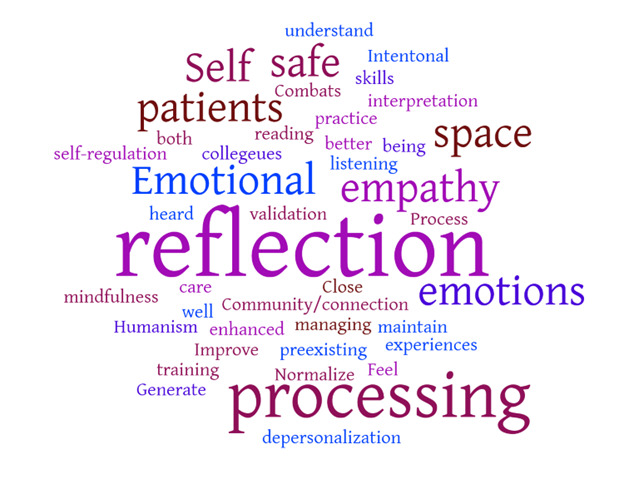
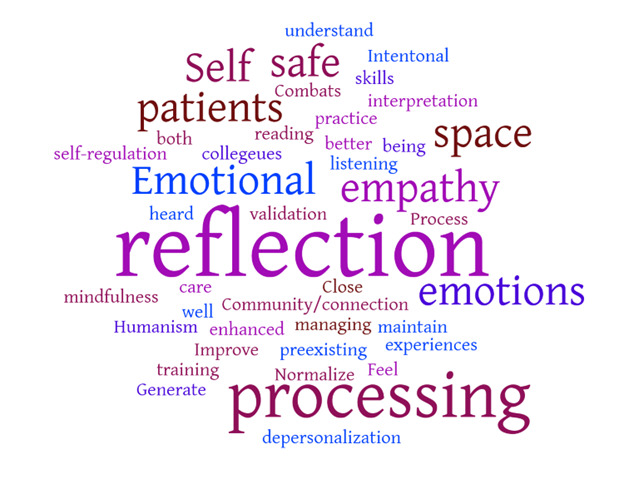
Figure 2 below visualizes the skills and traits participants reported that they gained from their participation in the LEAD program using data drawn from the interview transcripts.
DISCUSSION
By incorporating NM training into the LEAD program, educators at the Baylor College of Medicine aim to teach narrative competence as a foundational advocacy skill and promote resilience amongst trainees. Based on our findings, graduates of the LEAD program not only have positive perspectives about the effectiveness and impact of the NM component of their training but also perceive that it led to a range of positive outcomes including enhanced abilities to advocate and persevere.
Analysis of interview responses revealed specific core themes centered on strengthened patient connections, increased empathy and advocacy abilities, and reduced provider burnout. Further, the specific words that the LEAD graduates used to describe their experience (Figure 2) indicated that the NM training component helped them develop the personal skills necessary not only for addressing their patients’ needs and helping them navigate the healthcare system more effectively, but also for excelling in their residency training. Although the word ‘advocacy’ does not appear in the cloud, the terms that do appear reflect the program’s fundamental building blocks.
The survey responses offer complementary evidence, showing that participants recognized value in the LEAD track, its advocacy focus, and the NM component of the program. Overall, residents believed that the NM training enabled them to be more effective as both physicians and advocates. While statement seven in the survey: “You will continue to use narrative medicine for the foreseeable future of your practice” received the lowest average score (Figure 1), this same participant also noted that while they did not plan to incorporate NM techniques in their current/future practice—due to increased time constraints—they still recognized its personal and professional benefits during residency and emphasized the impact of NM on allowing them to better empathize during every patient encounter, underscoring its lasting impact. Thus, while the additional time necessary to engage in NM may prevent its utility as a clinical tool for some providers, its power as a personal and professional tool is still meaningful.
LEAD track graduates reported that their NM training equipped them to bring a more holistic approach to patient care and serve as better advocates for their patients. Interestingly, many residents noted the benefits of NM in managing their day-to-day life as residents, including meeting the challenges of maintaining high-quality care during long workdays, especially as patient visits begin to feel routine—an understandable difficulty given that, on average, pediatricians see around 25 unique patients daily (Forrest et al. 1999; American Academy of Pediatrics Department of Practice 2009). Despite these obstacles, LEAD graduates consistently advocated for “empowering patients to take ownership of the treatment process,” by giving them a safe space to share their concerns or objections to treatment plans and encouraging them to remain active participants in their own care.
LEAD graduates also expressed that the NM component helped them find space to be less reactive and more empathetic with patients. This may be attributed to the fact that the LEAD track included several reflective writing and reading assignments, providing residents with increased exposure to and discussions about unique patient perspectives and experiences often overlooked in traditional medical training. According to interview transcripts, this helped the residents “better interpret the stories” of their patients, which allowed for having more focused conversations with them, which supported the goal of “patient empowerment.” This echoes existing NM research findings about the role it plays in enhancing attention, representation and affiliation with patient stories (Zhao et al. 2023).
Another theme identified was a feeling of depersonalization during residency, with resident trainees reporting feeling inhuman at times. Through the collaborative reflection activities, residents expressed a sense of community and humanity that was brought back into medicine for them, helping them persevere. Despite the complexities of their patient cases and difficult working schedules, participants stated that “narrative medicine helps us [LEAD graduates] understand core values” and “remain grounded.” While the surveys were not designed to elicit these kinds of responses, the theme that NM training reversed feelings of depersonalization during residency naturally emerged in multiple conversations. Because it is critical to acknowledge that all trainees might experience these feelings during their training, we suggest that the findings from this study should be shared with other medical educators at all levels of training.
Our thematic analysis also revealed residents’ perspectives that their NM training not only improved their clinical practice but also equipped them for ongoing professional growth by reducing or helping to manage burnout. This particular feedback is consistent with current literature (Goldshore et al. 2014; Minkovitz et al. 2014), and is especially notable given that the pediatric populations that residents serve tend to have complex needs—increasing the likelihood of provider burnout (Olson et al. 2015). While residents did acknowledge that NM is not a complete solution, they expressed its important role in coping with the problem of physician burnout.
This study also had some limitations that should be acknowledged. First, the absence of a control group that did not receive NM training precluded a comparative analysis. This study, however, did not aim to compare outcomes between different groups of residents; rather, it aimed to gather feedback from a limited number of residents who graduated from this highly specialized track, negating the need for a control group. Another limitation was the study’s small sample size (n=10); however, this was a result of the LEAD track being relatively new. To date, there have been four graduated classes (2020-2023); as a result, the 10 graduates we interviewed (of the 15 total) constituted the majority of LEAD-trained pediatricians at the time. Despite the small sample, thematic saturation was reached; for qualitative analysis, this indicates a sufficient sample size.
We also acknowledge that there was likely self-selection bias, as some participants reported choosing the LEAD track due to their previous interests in medical humanities and advocacy. As a result, some residents’ intrinsic inclinations towards these interests may have confounded our thematic analysis and survey ratings. However, responses to our first interview question, “What were your initial impressions of narrative medicine and patient advocacy, if any, prior to commencing the residency training program?” showed that half (50%) of interviewees were unfamiliar with or completely unaware of NM before starting the track, while responses to interview questions two and five, showed that most (90%) of the participants believed not only that NM became an accessible tool after their residency training, but also that it allowed them to improve their advocacy abilities to better support their patients. Finally, we acknowledge that some of the survey statements were phrased in a way that could potentially encourage more positive Likert ratings or be interpreted as leading questions, increasing the potential for response bias. However, there was strong convergence between the qualitative and quantitative results from the open-ended and Likert-scale questions, respectively, suggesting that more neutral Likert scale questions would have likely still elicited similar responses.
Future studies should look to assess the long-term impacts of NM curricula on advocacy training as well as burnout prevention; this might be achieved by comparing responses from more recent to longer-term graduates to evaluate the sustained influence of NM in advocacy education. Further exploration of the real-world actions and impact of participants’ advocacy efforts could also be assessed, as this study was solely focused on the effectiveness of the LEAD track’s NM component in developing advocacy skills, as understood through the perspectives shared by graduates of the program.
Overall, the themes identified from the interview transcripts and assessment of the survey responses reinforce each other. These findings indicate that graduates of Baylor College of Medicine’s LEAD track perceived their training positively and identified the NM training component as helpful in their personal and professional lives. Specifically, graduates attribute their NM training to the development of skills that can be applied to their future advocacy efforts. Given the current absence of a standardized advocacy curriculum, findings from this study could be applied to help shape the development of a structured model for integrating NM and advocacy training into medical education.
In addition to supporting physicians during patient encounters, the competencies reinforced by the NM based training also may have enabled these clinicians to better advocate at the population and policy level. Increased mindfulness and an improved understanding of the patient experience can help clinicians recognize patterns and recurrent sources of poor health across multiple patient populations (Burgess et al. 2017; Brun et al. 2023). Reflective writing has been shown to help providers organize seemingly disconnected clinical experiences into cohesive narratives, while storytelling techniques can be used to translate multilayered medical encounters into concise and engaging messages for non-clinical audiences (Artioli et al. 2021). Practically, these skills may enable physicians in training to aggregate thematic evidence for policy briefs, craft compelling op-eds, and present their views to legislators—activities already practiced in the LEAD curriculum (e.g., writing exercises, storytelling workshops, and state capitol visits).
By enhancing pediatric providers’ capacity to empathize, self-reflect and engage in meaningful interactions, NM training can encourage and support pediatricians to advocate for patients in their daily clinical practice—benefiting individual patient care and the broader healthcare system. The promising results of our preliminary study highlight the positive effects of using a NM curriculum to cultivate advocacy skills among pediatric residents, ultimately positioning emerging pediatricians to be more effective advocates for their patients and communities.
Acknowledgements
The authors wish to thank the LEAD program graduates as well as their program director, Dr. Lanessa Bass, for their time and participation in developing this manuscript.
Author contributions
All authors contributed to the study’s conception, theoretical framework and experimental methods. NR conducted the interviews and DM and AR analyzed the interview transcripts. All authors contributed to interpretation of the findings, drafted the original manuscript, and critically revised the final version. All authors approved the final version for publication and are responsible for the accuracy and integrity of the content.
Declaration of Competing Interests
The authors declare they have no competing interests.
Funding
This work did not receive any external funding.
Abbreviations
ACGME, Accreditation Council of Graduate Medical Education
LEAD, Leaders Evaluating and Addressing Disparities
NM, Narrative medicine